

Sep 25, 2026 | 03:00
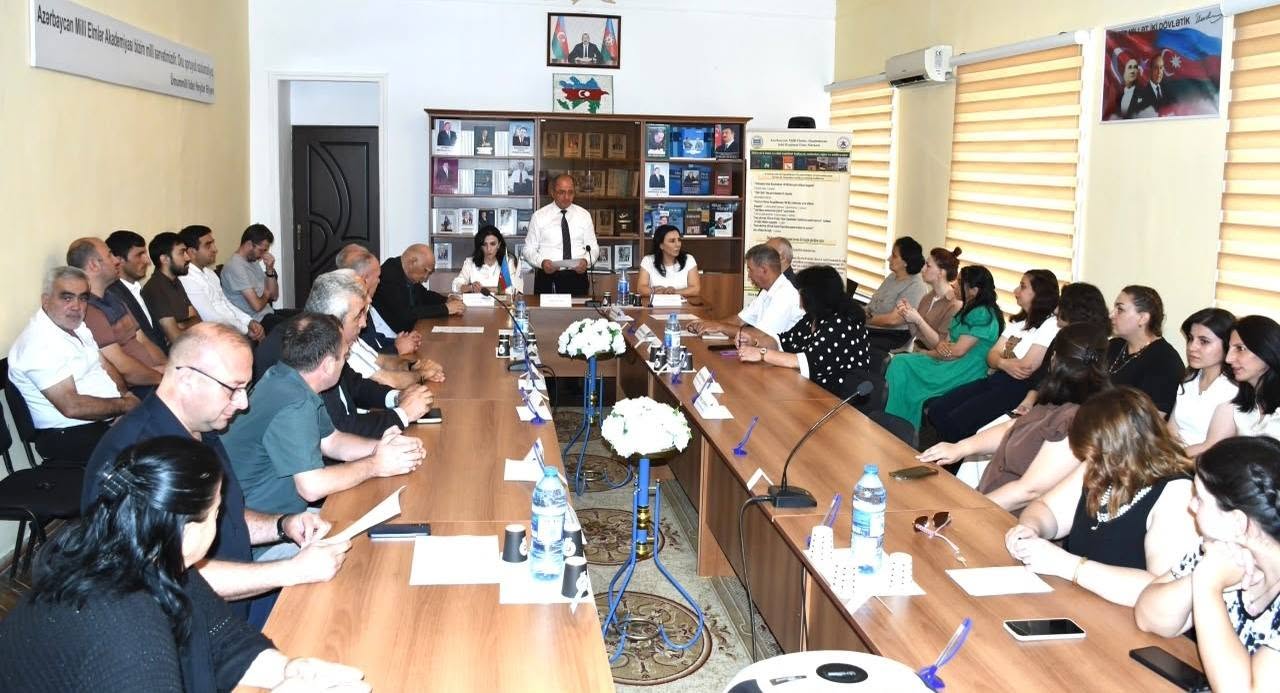
On September 25, 2026 the next scientific council was held in ANAS Sheki Regional Scientific Center.
In the meeting 12 members of Scientific Council, department heads and scientific workers were participated.
The director of Sheki Regional Scientific Center, Doctor of Philological sciences, docent Kamil Adishirinov opened the meeting and introduced the agenda to the participants. The agenda was voted and adopted.
In the meeting the issue concerning the decision of the Presidium of ANAS dated September 17, 2026, No. 17/1 regarding the implementation of the Order of the President of the Republic of Azerbaijan dated August 20, 2026 on the approval of the "State Program for the Development of Tourism in the Republic of Azerbaijan for 2026–2030" was discussed.
Elshan Abdurahmanov, head of the Archaeology and ethnography department, spoke on the matter.
In his speech Elshan Abdurahmanov discussed the rich historical-cultural heritage, ethnographic diversity, and ancient settlements of the North-West region, highlighting the opportunities they present for tourism development; he emphasized the importance of studying this potential on a scientific basis, preserving it, and integrating it into the tourism sector.
The department head drew attention to the significance of the region's location along international tourism routes for promoting its historical-cultural heritage and expanding its tourism capabilities. He noted the importance of developing various projects involving the departments of the scientific research institution in this direction. Elshan Abdurahmanov put forward proposals for establishing open-air museums at archaeological excavation sites and incorporating these locations into existing tourism routes. In his view, such an approach would allow ancient settlements and archaeological heritage to be presented to visitors in a more vivid and tangible manner.
During the speech, a number of proposals were also made regarding the utilization of the region's rich ethnographic heritage to expand tourism opportunities. Particular emphasis was placed on the importance of preserving and promoting ethnographic customs—specifically those related to family traditions and domestic culture—showcasing them to tourists, and highlighting examples of the national cuisine.
Elshan Abdurahmanov stated that a scientific approach and the development of comprehensive projects play a crucial role in transforming the region's historical, cultural, and ethnographic heritage into tourism products.
A conceptual tourism model, developed by Farhad Azizov head of the Plant biodiversity and genefund department and PhD in biology was also presented at the meeting.
Farhad Azizov noted that the model was prepared with due regard for the State Program on Tourism Development in the Republic of Azerbaijan, state programs for the socio-economic development of the regions, and key provisions of decisions and documents aimed at ensuring public employment.
The presentation addressed the region's natural and biological diversity, opportunities for the efficient use of existing resources, and their role in developing tourism potential. The conceptual model envisions tourism development not merely as an expansion of leisure and travel opportunities, but also as a comprehensive utilization of the region's natural, scientific, cultural, and socio-economic resources. The presented model highlights opportunities for developing nature-based tourism, educational tourism, and the integration of local resources into the tourism sector. It also notes that implementing such projects could contribute to local employment and create new economic opportunities.
Huseyn Mustafabeyli, head of the Landscape science department and PhD in geological-mineralogical sciences, also presented proposals regarding tourism development during the meeting.
He emphasized the importance of making greater use of Sheki’s rich historical and cultural heritage to expand tourism potential. In this regard, he proposed installing statues of the Sheki Khans—Chelebi Khan, Huseyn Khan Mushtaq, Mahammadhasan Khan, and Salim Khan—in the areas surrounding the Sheki Khan's Palace.
He noted that such an initiative could help raise awareness of the historical figures of the Sheki Khanate, enrich the city's historical and cultural character, and create new points of interest for tourists. It was also emphasized that equipping the sites where the statues are located with appropriate information plaques and historical details would enable visitors to gain a more comprehensive understanding of Sheki’s history.
Views were exchanged regarding the proposals, and it was deemed appropriate to evaluate them within the framework of the tourism concept.
Subsequently, Rahim Hasanov, head of the History and epigraphy department at Sheki Regional Scientific Center and PhD in history, spoke about the Presidium of ANAS Decision No. 17/2 dated September 17, 2026, concerning the implementation of the Order dated July 31, 2026, on the approval of the Action Plan to prevent and neutralize negative propaganda directed against the international image, history, and culture of the Azerbaijani state.
He discussed the importance of conveying Azerbaijan's rich history and centuries-old cultural heritage to the international community in an accurate, objective, and scientifically grounded manner. The speaker emphasized that disseminating scientific research on various periods of Azerbaijani history, as well as information regarding historical monuments and epigraphic examples, to a broad audience plays a crucial role in promoting the country's historical and cultural heritage.
The department head proposed presenting scientific and educational materials related to historical and cultural heritage to a wider audience through the use of modern information technologies. In this regard, he suggested that it would be appropriate to upload informative videos in English covering Azerbaijani history, cultural heritage, historical monuments, and the results of scientific research to Sheki Regional Scientific Center’s YouTube channel.
Rahim Hasanov noted that such materials, produced in English, could facilitate the dissemination of objective information about Azerbaijan's history and culture to foreign audiences and help promote its scientific and cultural heritage internationally. The next item on the meeting agenda concerned new appointments at Sheki Regional Scientific Center, in accordance with Decisions No. 17/17 and 17/18 of the Presidium of ANAS, dated September 17, 2026.
Director Kamil Adishirinov presented information on the matter. He announced that, pursuant to the relevant decisions of the ANAS Presidium, Vafa Atayeva had been appointed Deputy director for Scientific affairs and digital development, and Ayshan Salmanova had been appointed Scientific secretary of Sheki Regional Scientific Center.
The Director congratulated the staff members on their new appointments and wished them success in their work. He noted that the effective execution of tasks related to scientific affairs, digital development, and the role of scientific secretary is crucial for further enhancing scientific activities at the Center, coordinating research work, and expanding the use of modern digital capabilities. Subsequently, Namig Abdurahmanov, head of the Digitalization and artificial intelligence department at Sheki Regional Scientific Center, delivered a presentation titled "Digitalization of the Literary-Cultural Environment and Folklore Based on Artificial Intelligence." The presentation addressed the preservation and systematization of literary-cultural heritage and folklore examples, as well as the enhancement of their accessibility in the digital environment, through the use of modern digital technologies including artificial intelligence.
At the conclusion of the meeting, current issues were reviewed, and appropriate decisions were adopted regarding the agenda items.