

Jul 23, 2026 | 03:39
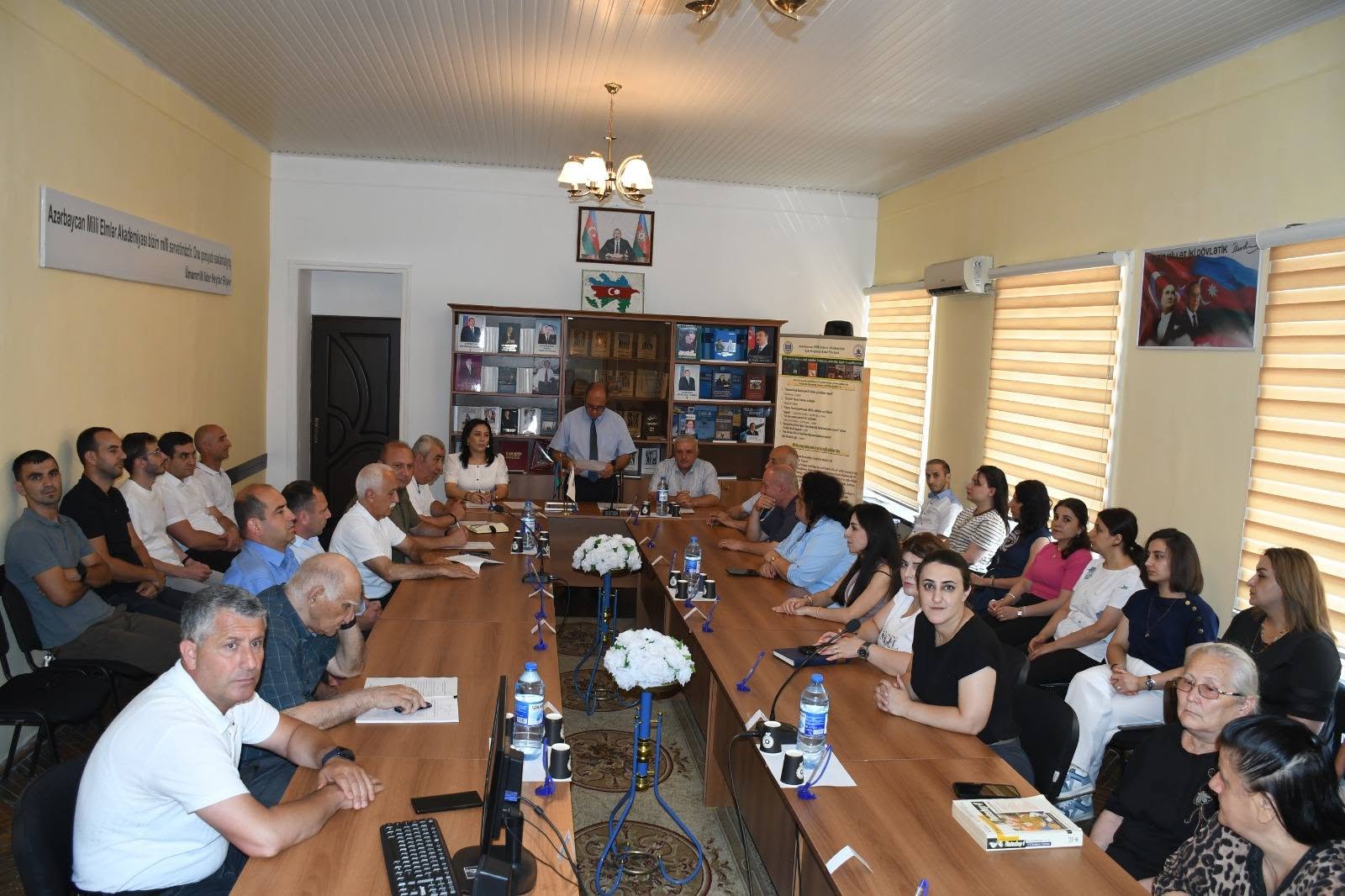
On June 23, 2026 the next meeting of Scientific Council was held in Sheki Regional Scientific Center of ANAS.
11members of Scientific Council, department heads and scientific workers participated at the meeting.
Opening the ceremony the director of Sheki RSC, Doctor of Philology, docent Kamil Adishirinov paid attention the agenda to the participants. The agenda was accepted by woting.
The main discussion object of the meeting was improving the evaluation criteria of the scientific actions in ANAS.
Regarding the decision No. 15/2 of the Presidium of ANAS dated June 17, 2026 "On the evaluation of the activities of scientific employees working in scientific institutions and organizations of ANAS based on the point system", the director of Sheki REM, associate professor Kamil Adishirinov, made a speech and provided detailed information about the main provisions and implementation mechanisms of the decision. He noted that the new evaluation system serves for valuing scientific action with more objective and clear criteria. The director stressed the characteristics of the different scientific fields, the functional possession of the employees and considering scientific results during the application of the decision. Besides that he invited the participants to sound their comments and offers about the decision and noted that these offers and comments will be presented.
Professor Firadun Ibrahimov noted that valuing the action of scientific worker is realized not only for scientific degree and scientific name but also for considering their position, their functional commitment and the scope of work during a year. According to him, applying the same evaluation criteria to employees with different roles and functions does not yield objective results. In this regard, positions within scientific institutions should be categorized, the core functions of each role clearly defined, and evaluations conducted based on the level of performance of those specific functions.
The professor emphasized the need for a differentiated approach to the various areas of an employee's work—such as scientific research, scientific-organizational tasks, and other activities—ensuring that each type of activity is evaluated according to its significance. He also noted that the development of evaluation criteria should be grounded in the requirements of existing regulations while taking into account the specific operational characteristics of each structural unit. In his view, this approach would not only ensure transparency and objectivity in the evaluation process but also serve to more effectively incentivize the work of scientific personnel.
In her remarks, Scientific Secretary Vafa Atayeva highlighted the need to include employees who engage in scientific activities but do not hold the official title of "researcher" when developing assessment criteria. She noted that employees in this category actively participate in various scientific-organizational tasks, project implementation, the organization of scientific events, the preparation of scientific publications, and other areas of scientific activity. However, the absence of specific assessment criteria for their work makes it impossible to evaluate their contributions objectively.
Vafa Atayeva proposed developing separate assessment criteria for employees who contribute to scientific activities but lack the status of a researcher, taking their functional duties into account. According to her, this approach would facilitate the objective evaluation of their work while also boosting their interest and motivation regarding scientific-organizational activities.
Speaking on the subject, Ilgar Ismayilov, Head of the Department of Ecological Biophysics and PhD in Agricultural Sciences, shared his views regarding the current criteria for evaluating articles, monographs, and other scientific publications. He noted that 15 points are allocated for each article published in journals indexed in international scientific databases. In this context, he argued that it is inappropriate for an author who has published three such articles to be denied full credit for the 45 points earned simply because of a 40-point cap. Ilgar Ismayilov proposed removing this limitation so that the full 45 points for three international articles could be counted. He also emphasized the importance of applying different evaluation criteria for international versus domestic conferences, as well as for online versus offline ones, and of establishing specific criteria for scientific reviews and minor publications of practical significance. Furthermore, he suggested clarifying whether the evaluation criteria planned for 2026 would actually be implemented in 2027.
Head of the Department of History and Epigraphy, PhD in History In his remarks, Rahim Hasanov emphasized the importance of taking the specific characteristics of different scientific fields into account when evaluating scientific publications. He noted that there are significant differences in volume and content between books published in technical and natural sciences and works produced in the humanities. Therefore, the evaluation process should consider not only general criteria but also the work's volume, page count, and the specific nature of the scientific field.
Rahim Hasanov also noted that, when evaluating scientific activity, primary emphasis should be placed on scientific results and research outputs. In this regard, it would be appropriate to reduce the points awarded for media appearances and, conversely, assign higher value to scientific publications and fundamental research. He also proposed evaluating the active participation of Scientific Council members in meetings and scientific management processes using a points-based system, stating that this would help incentivize scientific-organizational activities.
Farhad Azizov, Head of the Plant Biodiversity and Gene Pool Department and PhD in Biology, noted in his remarks that, to ensure an objective evaluation of researchers' performance, the operational areas and responsibilities of each department must first be clearly defined. He pointed out that since departments have diverse profiles and do not share the same areas of activity, the application of uniform evaluation criteria does not always reflect actual results. He suggested that it would be more appropriate to revise the regulations for each department and formulate evaluation criteria in alignment with those regulations. Aladdin Sultanov, a senior researcher in the Department of History and Epigraphy and a PhD in History, emphasized the importance of clearly defining criteria for evaluating co-authored scientific articles. He noted that, as the majority of recent scientific research results from the collaboration of specialists across various fields, co-authorship has become an integral part of scientific activity. Therefore, clear criteria need to be developed to ensure that the scientific contributions of the authors are objectively taken into account when evaluating such articles.
Aygun Ismayilova, a researcher in the Department of Environmental Geography, proposed developing specific criteria for evaluating the work of senior laboratory assistants, as well as establishing concrete criteria for assessing patent-related activities.
It was decided to consolidate the proposals and opinions voiced during the discussions and submit them to the relevant authorities. Subsequently, the publication of the book titled "Methodological Guidelines for the Preparation of Bulgarian Artificial Feed (Chau) and the Incubation and Rearing of *Bombyx mori* L. Silkworms"—co-authored by Associate Professor Gudrat Bakirov, a staff member of the Sheki Regional Scientific Center—was discussed as a current agenda item. During the discussion, the scientific and practical significance of the publication was highlighted, and it was deemed appropriate to submit the book for expert review in accordance with established procedures. The Scientific Council resolved to submit the work to relevant specialists for evaluation.
In the conclusion of the meeting, Elvin Garayev, a staff member of the Department of Ecological Geography, was presented with a Certificate of Appreciation by the leadership of the Sheki Regional Scientific Center in recognition of his active participation in the department's environmental monitoring activities, field research expeditions, and scientific studies.