

May 19, 2026 | 06:00
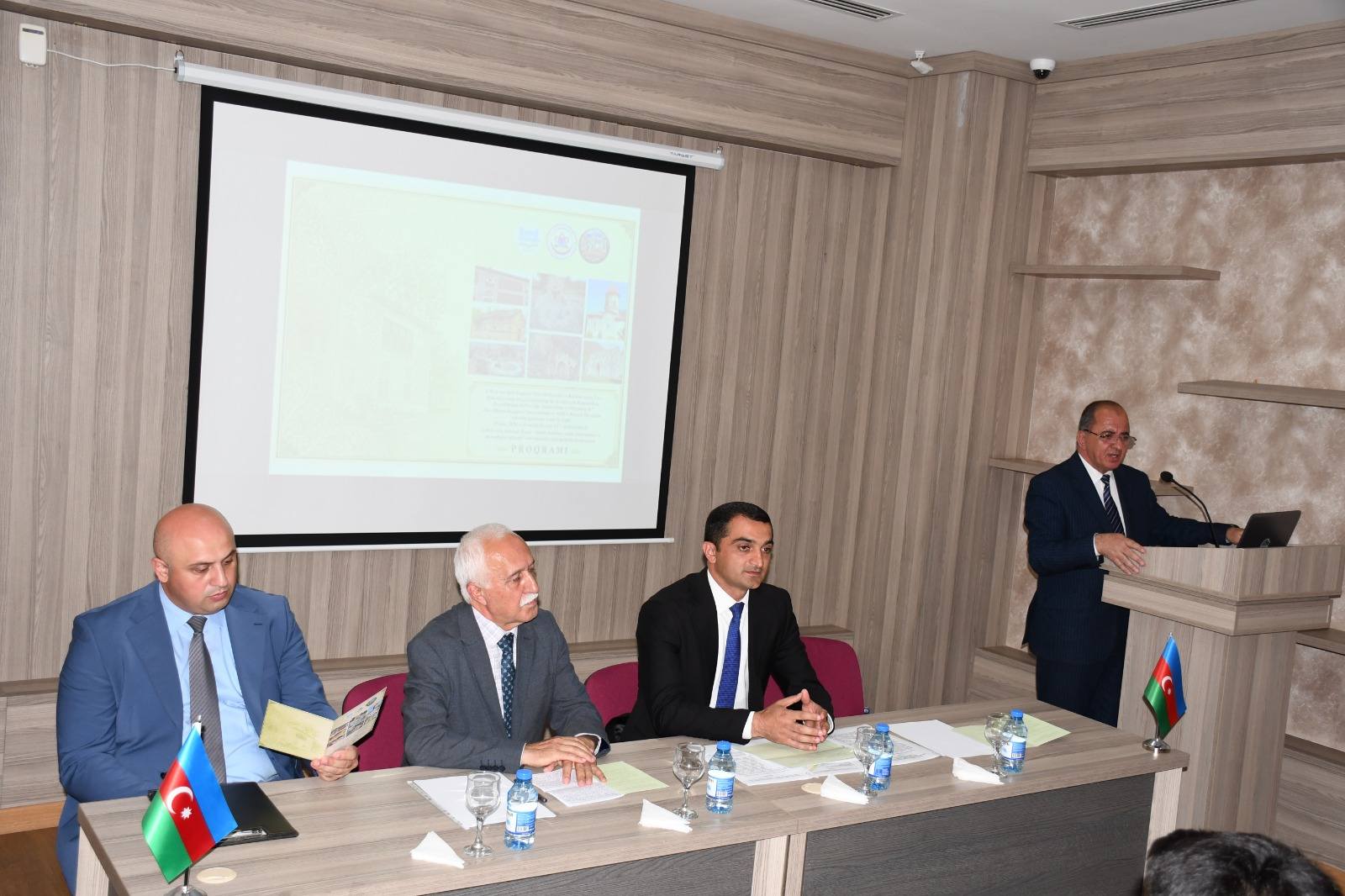
On May 19, 2026, a scientific-practical conference on the topic “Development of urban planning and architecture in North-Western Azerbaijan in the Early Middle Ages” was held in Balakan, jointly organized by Sheki Regional Scientific Center of ANAS and Balakan District Executive Power, within the framework of the “Year of Urban Planning and Architecture”.
Cultural workers, teachers and public representatives of Balakan district participated in the event.
First, the National Anthem of the Republic of Azerbaijan was played. The dear memory of the sons of the Motherland who gave their lives for the independence and territorial integrity of our lands was commemorated with a minute of silence.
Opening the event, Deputy Head of the Balakan District Executive Power Turan Dibirov said that the study and promotion of our history, national-cultural heritage, as well as ancient urban planning and architectural traditions in our country is one of the important directions of state policy. He noted that the main goal of the event is to study the ancient urban planning and architectural traditions of North-West Azerbaijan, to study and promote the historical and cultural heritage of the early Middle Ages, as well as to inform the public about scientific research conducted in this field.
Making an introductory speech at the event, the acting director of Sheki RSC, Doctor of Philology, docent Kamil Adishirinov said that the conference was organized within the framework of the measures taken to implement the Decree of the President of the Republic of Azerbaijan on the “Year of Urban Planning and Architecture”, as well as the relevant decision of the Presidium of the Azerbaijan National Academy of Sciences.
The docent emphasized that the conference is important for conducting scientific exchange of views among scientists, researchers, architects and public representatives, investigating the importance of ancient settlements and architectural examples in terms of urban planning, as well as expanding cooperation in promoting the historical and cultural heritage of the region.
The speaker also informed about the implemented and planned events and noted that work will continue in the direction of preserving historical and cultural heritage, studying archaeological monuments, preparing scientific publications and involving young researchers in this field.
He noted that such scientific and practical conferences make a significant contribution to strengthening cooperation between scientists and researchers, expanding scientific exchange of ideas and deeper study of the historical and cultural heritage of the region. The associate professor wished the conference success and expressed confidence that the event will be remembered for its high scientific results.
Later, scientists and researchers of Sheki Regional Scientific Center, as well as intellectuals of Zagatala and Gakh regions, presented reports on the urban planning traditions, architectural features, and work done to preserve and pass on historical monuments to future generations in the region in the early Middle Ages.
At the conference, Akif Mammadli, a senior researcher at the Department of History and Epigraphy of Sheki RSC, Ph.D. in History, delivered a report on the topic “Urban planning and architectural traditions in the ancient and early Middle Ages in the Balakan-Zagatala region”. He provided extensive information on the ancient settlements, defensive structures, architectural features, and urban planning traditions of Balakan, and emphasized the importance of studying and protecting historical monuments.
Akif Mammadli noted that in the residential and defensive structures built in Balakan in the ancient and early Middle Ages, along with local architectural traditions, the architectural features of the Caucasian Albania period were also reflected. He noted that at that time, urban planning principles were established in accordance with natural and geographical conditions, and settlements were mainly built in areas close to water sources and trade routes.
The speaker emphasized that the historical monuments located in Balakan are not only architectural examples, but also important indicators of the ancient statehood and cultural history of our people. In conclusion, he noted the importance of protecting these monuments, scientifically studying them and passing them on to future generations.
At the conference, Elshan Abdurahmanov, head of the Archaeology and Ethnography department of the Sheki RSC, delivered a report on “Early Medieval Architectural Monuments of Sheki Province of Caucasian Albania”. He noted that Sheki and the surrounding regions were one of the important cultural, religious and administrative centers of Caucasian Albania, and numerous architectural examples of the early Middle Ages have been preserved here to this day.
The speaker noted that the ancient temples, defensive structures, residential areas and tombs located in the region testify to the high architectural and construction traditions of that period. He provided detailed information, in particular, on the stone masonry technique, the layout of the buildings, and the unique features of religious architectural examples.
In his speech, Elshan Abdurahmanov emphasized that temples are not only places of religious worship, but also strategically important points. He noted that a number of temples built in the early Middle Ages were built on heights, in areas with control over passageways and settlements.
The researcher also spoke at length about new monuments discovered during archaeological excavations he has conducted in recent years. He noted that as a result of the research, early medieval settlements, necropolises, and other archaeological materials were discovered in various areas of the region. He noted that the findings are of great scientific importance in terms of a deeper study of the urban planning and architectural history of Caucasian Albania, as well as the material and spiritual culture of the period, and the religious-mystical worldview against the background of these monuments.
The speaker concluded by stating that the protection and systematic study of archaeological monuments is essential for the study of our ancient history, and noted that newly discovered monuments will be included in scientific circulation in the future.
Speaking at the conference, Anar Lachinov, Director of the Zagatala Historical and Cultural Heritage Reserve, operating under the State Service for the Protection, Development and Restoration of Cultural Heritage under the Ministry of Culture, stated in his report on the topic “The Past and Present of Zagatala Architecture” that Zagatala district is one of the distinguished regions of Azerbaijan with its rich historical and cultural heritage, ancient settlements and architectural examples. The speaker provided extensive information on the architectural features of the historical monuments located in the district, the history of their creation and the work done to preserve them to this day.
During his speech, he also brought to the attention of the participants a list of a number of historical and architectural monuments existing in Zagatala district. He noted that these monuments are important examples of the historical past, architectural traditions and national and cultural heritage of the region, and the protection of these historical and architectural monuments and their transfer to future generations is the moral duty of every citizen. He invited the teachers participating in the conference to actively participate in educational events and to be active in organizing excursions for students.
Also at the conference, the director of Gakh District Museum of History and Local Lore, Mahir Efendi, delivered a report on the topic “Traces of historical and cultural heritage in terms of urban planning and architectural solutions in Gakh District”. In his speech, he noted that Gakh District is one of the regions with ancient history and rich architectural heritage, and that urban planning traditions from various historical periods have preserved their traces even today.
In his speech, Mahir Efendi also provided information about a number of historical and architectural monuments located in Gakh District, noting that these monuments are valuable historical sources reflecting the social and cultural life of the region in terms of both architectural style and urban planning.
The speaker also noted that the measures taken to protect and restore the historical and cultural heritage in Gakh District also make a significant contribution to the development of the region's tourism potential. He emphasized the importance of studying ancient architectural examples on a scientific basis and passing them on to future generations. At the end of the conference, a wide exchange of views was held on the topic. It was noted that such scientific and practical events make a significant contribution to a deeper study of the rich historical heritage of the region, obtaining new scientific results, and promoting our history among the general public.