

Apr 03, 2026 | 02:00
An event dedicated to Science Day was held in Sheki Regional Scientific Center
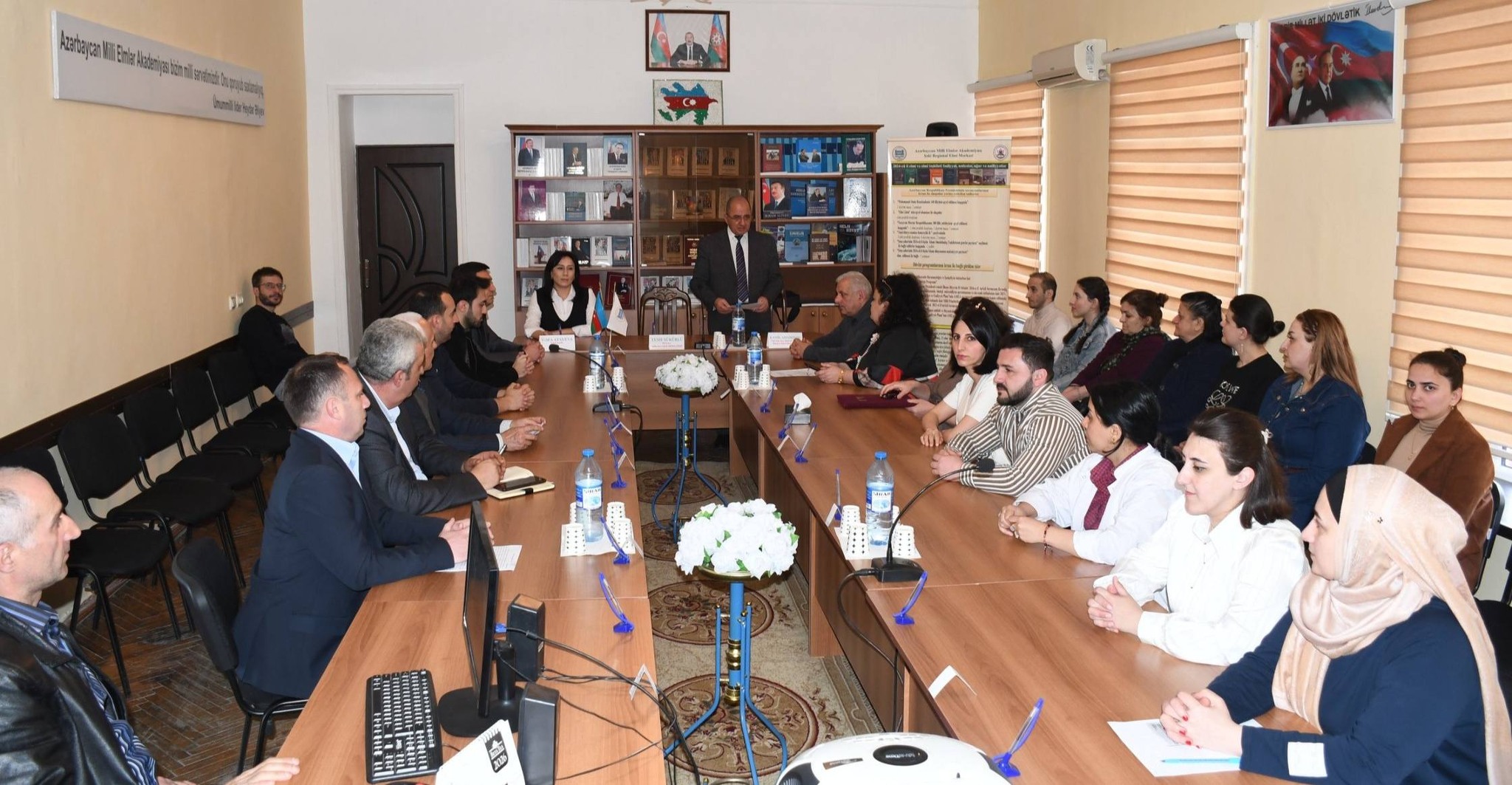
On April 3, 2026, an event on the theme “Science is the lamp of thought” was organized in Sheki Regional Scientific Center of ANAS on the occasion of March 27 - Science Day.
At the event, employees of the center and scientists made reports on various topics.
Opening the event with an introductory speech, deputy director on scientific affairs of Sheki RSC, Doctor of Philology, docent Kamil Adishirinov spoke about the importance of March 27 - Science Day. He noted that Science Day was established in accordance with the relevant decree of the President of the Republic of Azerbaijan and is of great importance in terms of increasing attention to the development of science in the country.
The associate professor emphasized that the development of science in Azerbaijan is one of the priority directions of state policy and consistent measures are being taken in this area. According to him, such events create conditions for the expansion of scientific discussions among scientists, the formation of new ideas and the exchange of experience.
He also noted that the involvement of young researchers in scientific activities, supporting their initiatives and increasing their activity in the scientific environment plays an important role in the formation of future scientific potential.
Kamil Adishirinov wished success to the event and congratulated the scientists on their professional holiday.
Senior Researcher of the department of History and epigraphy, PhD in History Akif Mammadli, speaking on the topic “Representatives of Science and Knowledge of Balakan in the 19th–20th Centuries”, provided information about the scientific and cultural environment of the northwestern region of Azerbaijan, especially the Zagatala–Balakan region.
Akif Mammadli presented the topic “Representatives of Science and Knowledge of Balakan in the 19th–20th Centuries” in his speech and spoke about the rich scientific and cultural heritage of the northwestern region of Azerbaijan.
He noted that the Zagatala–Balakan region has historically been one of the centers of science and spirituality. Referring to the notes of foreign travelers about this area, the speaker said that the region attracted attention not only for its natural beauty, but also for its educated and intelligent people. He noted that the travelers' writings emphasize the local population's special interest in science, books, and education.
Akif Mammadli made a special mention of the tradition of book donation that existed in Balakan, stating that it had a significant impact on the spread of science in the region. According to him, intellectuals contributed to the development of enlightenment by donating religious and scientific books to madrasas or individuals. As a result of this tradition, a rich book environment was formed in the region.
The report also touched on the Tala script of the Arabic alphabet. It was noted that the spread of this writing style in the region indicates the development of writing culture here and that local scholars have also achieved certain achievements in the field of calligraphy, which in turn is an indicator of the high value placed on science and knowledge.
Akif Mammadli also spoke about the influence of the Naqshbandi sect in the region. He noted that individuals affiliated with this sect played an important role in the spread of both religious and secular sciences.
Akif Mammadli also drew attention to the scientific activities of the Balakan intellectuals, emphasizing the impact of such works on the high level of literacy in the region and the development of scientific thought, and stated that the rich scientific and gnostic traditions of Balakan should be studied, researched and passed on to future generations even today.
Senior Researcher of the Department of History and Epigraphy, Doctor of Philosophy in History, Aladdin Sultanov spoke about the history and importance of the Arabic language in his speech on the topic “Arabic scholars of the 20th century of Azerbaijan”.
He noted that the Arabic language has played a major role for centuries not only as a means of communication, but also as a language of science, philosophy and culture. Especially in the Middle Ages, the majority of scientific works in the Middle East and the Caucasus region were written in Arabic, and this language acted as a means of international scientific communication. The speaker emphasized that Azerbaijani scientists also actively participated in this process and created valuable works in Arabic.
The report compared Arabic and Hebrew and stated that both belong to the Semitic language family and have similarities in terms of grammatical structure and lexical features. However, differences in terms of phonetic system, writing rules and some syntactic features were also brought to attention. Aladdin Sultanov also provided detailed information about the Arab scholars Azerbaijan has produced in different periods. He noted that scholars such as Khatib Tabrizi, Safiyaddin Urmavi, Gamaladdin Muhammad al-Ardabili, Muhammad b. Ahmad al-Huwayyi, Mahmud al-Arrani, Muhammad al-Tabrizi al-Qarabaghi and Abu Muhammad al-Varandi, who worked in the Middle Ages, made significant contributions to the field of Arabic philology and linguistics.
In his speech, touching upon the stages of development of Arabic studies in Azerbaijan in the 20th century, it was stated that despite the ideological restrictions existing during the Soviet period, a serious scientific school was formed in this field.
He noted that the Faculty of Oriental Studies of Baku State University acted as one of the main centers in the teaching and development of the Arabic language in Azerbaijan. The specialists trained at this faculty played an important role in the formation of the school of Arabic studies in the country.
He particularly emphasized the activities of such scientists as Professor Alasgar Mammadov, Professor Malik Mahmudov, Academician Aida Imanguliyeva, Academician Vasif Mammadaliyev, Academician Govhar Bakhshaliyeva, Professor Chimnaz Mirzazadeh and others. He noted that their research in the field of Arabic language, literature and translation has made a significant contribution to the development of Azerbaijani Oriental studies.
At the end of his speech, Aladdin Sultanov noted that the Arabic language is still relevant today and drew attention to the importance of studying it in the field of international relations, science and culture.
Head of the Department of Literary and cultural environment and folklore, PhD in philology Irada Yusifova presented in detail the topic “Scientific publications of the department of literary and cultural environment and folklore of the Sheki RSC” and spoke about the scientific research and publishing activities of the department over the years.
She said that during the period of its operation, the department has carried out important work in the direction of collecting, systematizing and publishing the rich folklore heritage of Sheki and the surrounding regions. She said that as a result of the research conducted in this direction, the intangible cultural heritage of both the region and Azerbaijan in general has been protected and passed on to future generations.
Irada Yusifova noted that the published works are not only a collection of folklore samples, but also have a scientific research character and play an important source in the fields of language, ethnography, history and literature. He emphasized the importance of collections such as “Sheki Folklore Anthology”, “Advice and Blessings from Our Elders”, “Medical Knowledge of Our Ancestors in Our Idioms” in terms of studying folk wisdom, customs and traditions and ancient knowledge.
The special place of the two-volume book “Neighborhood Names, Clans and Nicknames in Sheki” was noted in the report. It was noted that this publication is a valuable source reflecting the socio-structural features of the city, the clan-root system and local naming traditions. At the same time, it was brought to attention that works such as “Ancient Turkic-Oghuz Land Okhud” and “Goynuk District: Socio-Political, Cultural-Historical and Folklore” are important in terms of studying the historical and ethnic roots of the region.
Irada Yusifova also mentioned publications related to literature and the literary environment, noting that books such as "The Literary and Cultural Environment of Sheki in the 20th Century", "Ismail Bey Nakam: His Life and Artistic Creativity", "The Poetic Heritage of Yagub Mahir", and "Sabir's Satire Traditions in the Literary Environment of Sheki" have made a significant contribution to the study of the literary life of the region.
He emphasized that the department did not limit itself to local folklore, but also conducted research covering a wider geography. In this regard, publications such as “Azerbaijani and North American Indian Folklore” are important steps taken towards the comparative study of the folklore of different peoples.
In her speech, Irada Yusifova noted that new works also occupy an important place among the recent publishing activities of the department. It was noted that the book “Sheki Laughter and Gabrovo Humor” was published and presented to readers last year, and this publication covers a comparative study of the humor and laughter traditions of the Sheki region, as well as satirical and folklore elements related to Gabrovo. The speaker drew attention to the fact that the book presents the formation of the folk laughter culture, its social and cultural functions, as well as similarities and differences between different peoples on a scientific basis.
Speaking about the future directions of the department, Irada Yusifova emphasized that work will continue in the direction of collecting folklore materials, digitizing them and integrating them into the international scientific environment.
A speech was heard on the topic of youth and state policy in strengthening scientific potential in Azerbaijan.
Elvin Rustamov, Chairman of the Council of Young Scientists and Specialists of the Sheki RSC, presented a report on the topic of "Youth and state policy in strengthening scientific potential in Azerbaijan".
It was noted that the development of science in the modern era is closely related to the activity of young scientists, their involvement in scientific research and the created conditions. He noted that in recent years, important steps have been taken in Azerbaijan to increase young people's interest in science, and wide opportunities are being created for their integration into the international scientific environment.
During the speech, it was emphasized that as a result of the targeted policy implemented by the state, young researchers are provided with various grant programs, scholarships and opportunities to join scientific projects, which creates conditions for strengthening scientific potential in the country and developing innovative ideas.
Elvin Rustamov said that supporting the activities of young scientists in higher education institutions and scientific research institutes, ensuring their access to modern technologies and expanding educational opportunities abroad are among the main priorities of state policy and the main guarantees of the future scientific development of Azerbaijan.